
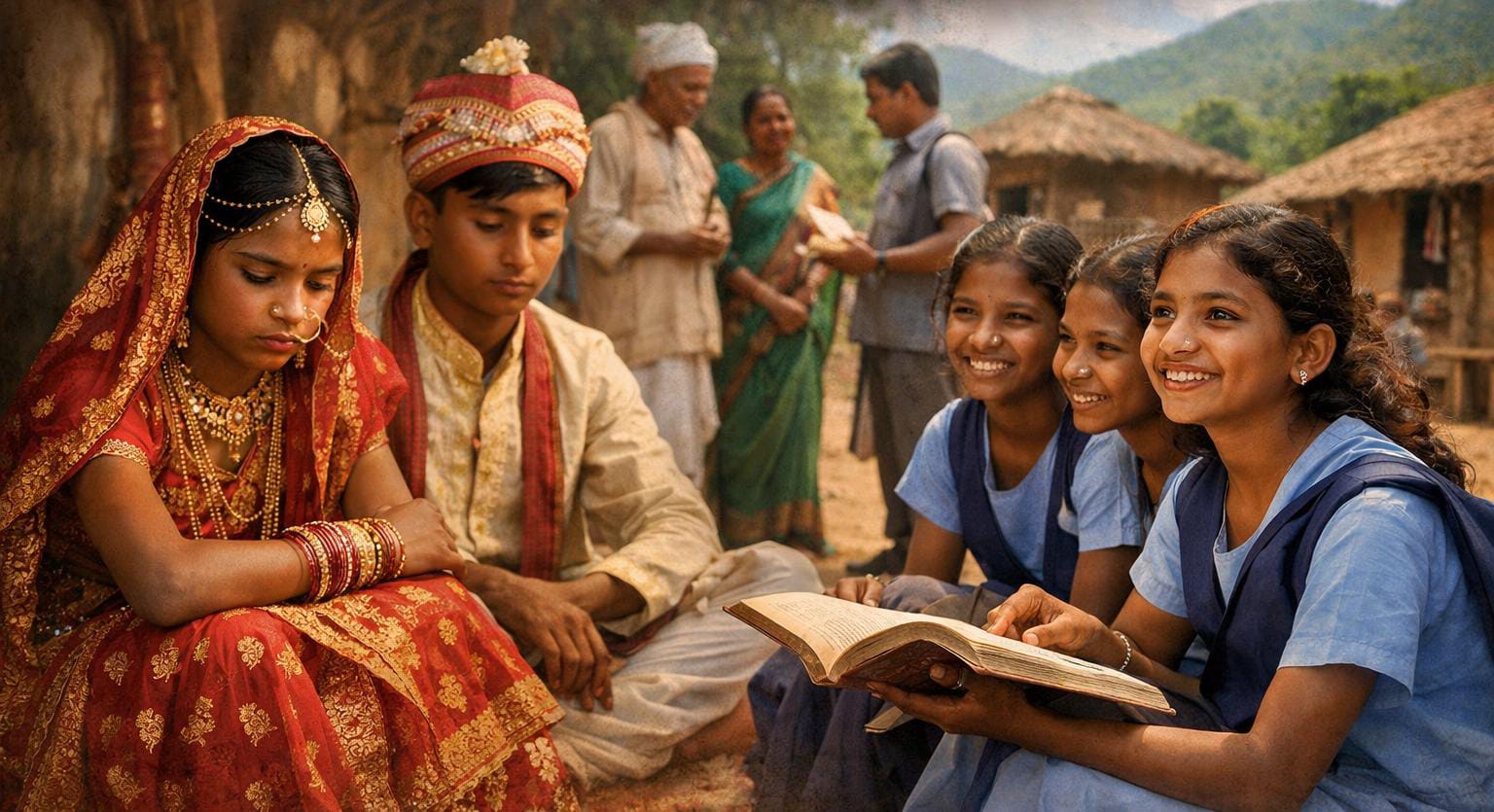
Breaking the Cycle, Preserving Childhood: Child Marriage in Tribal Odisha
While the practice is legally prohibited, its roots lie deep within social customs where early marriage is often seen as a way to secure a child’s future, protect family honour and reduce financial burden.

Child marriage remains a quiet but persistent reality in several tribal pockets of Odisha, shaped by generations of tradition, economic hardship and limited access to education. While the practice is legally prohibited, its roots lie deep within social customs where early marriage is often seen as a way to secure a child’s future, protect family honour and reduce financial burden. In remote villages, especially in districts with high tribal populations, marriage is not always marked by age but by physical maturity and community approval.
Yet, the narrative around child marriage in tribal Odisha is slowly changing. Increased awareness, improved schooling and the growing presence of grassroots organisations are opening new pathways for young girls and boys. Education has emerged as the strongest tool of transformation. Where schools are accessible and teachers engage with families, children are staying longer in classrooms, and parents are beginning to see education as an asset rather than an obstacle to tradition.
Tribal communities, often portrayed only through the lens of deprivation, are showing remarkable resilience and adaptability. Elders and local leaders are increasingly participating in dialogue with government officials, social workers and health volunteers. Many now understand the health risks and emotional toll early marriage can have on young girls, including early pregnancy and loss of childhood. These conversations, held in local languages and within cultural frameworks, are proving far more effective than enforcement alone.
Government schemes focused on girl child education, nutrition and health have also played a supportive role. Initiatives that offer scholarships, bicycles, hostels and healthcare services have reduced the pressure to marry daughters early. When families feel supported, they are more willing to delay marriage and invest in their children’s growth.
The story of tribal Odisha is not just about a social challenge, but about a community in transition. As education spreads and voices of young girls grow stronger, childhood is slowly being reclaimed. Ending child marriage here is not about rejecting culture, but about nurturing it in ways that protect dignity, health and hope for the next generation.
